Skip to content
SAM NYXON Search

Six series · Three standalone novels

The Reader’s Guide.

Discover the people and choices at the heart of Sam Nyxon’s stories. Explore a world, find where to begin, and follow the books in the order that suits the story.

Cover of The Last Flash We Ever Saw

Nuclear War

Day Zero

18 novels

Nuclear war begins with people who still believe they are in control. They calculate the force of a strike, wait for concessions, and prepare their responses. When communications fail, guesswork becomes the basis for orders whose consequences will be borne for years by people who never had a seat at the negotiating table.

The first strikes trigger others, and the world catches fire. Cities crumble, power grids go dark, and last conversations with loved ones are cut short. People take shelter, unsure whether they will see their families again or what will remain of their lives above ground.

In time, survivors begin to emerge, search for one another, and decide where to go. A home may still be standing, but water, electricity, and help no longer reach it. Feeding the children depends on a ship carrying grain—and someone securing its passage. Saving a patient requires medicine that must be manufactured again, even aboard a converted cruise ship. A CIA representative sits down to negotiate with a drug lord: he has the people, laboratories, and secure routes they need. Patients’ lives will depend on the deal, though they may never know who made their survival possible.

The rules change, little by little. The ability to deliver food or hold a port gives power over entire cities. Aid creates dependence; military protection becomes a means of making demands. New alliances form out of the wreckage of the old order. States that once had to yield to stronger powers see a chance to expand their borders. Intelligence services race terrorists to the nuclear weapons that survived, while black markets sell forged papers and children alongside fuel and antibiotics.

For a family in this world, a name missing from the records can be as insurmountable a barrier as a collapsed bridge. Evacuation does not always lead to safety, and someone promising protection may make a living from other people’s disappearances. Adults must decide whom to trust with those they love. Children must learn to recognize danger in the very people they look to for help.

Yet life returns. People sow fields, restart power stations, restore links between continents, and send a human being into space again. So much work and hope have gone into these achievements that an attack threatens far more than machinery. Sabotage at a nuclear power plant forces people from their homes once more. A blocked sea route cuts hospitals off from medicine. The restored internet provides a way in for commands that military systems accept as legitimate.

The consequences of the first war remain. Even sunlight breaking through the soot threatens crops and people because the ozone layer has been damaged. Protection from it becomes a bargaining chip. While some struggle to save the grain they have grown, others use that dependence to demand concessions. And where suspicions of sabotage meet national ambitions, orders are given once again to ready the weapons.

Day Zero is Sam Nyxon’s eighteen-novel series about nuclear war, survival, and the long return to life. Through the lives of heads of state, soldiers, intelligence officers, doctors, and families, it shows how one conflict changes an entire world—from its borders to the decisions people make for those closest to them.

Michael Wayne, Izzy, and others must unravel conspiracies, strike dangerous bargains, and act before they can verify every fact. Behind each decision are people who once lost everything and are now trying to protect the lives they have rebuilt.

Choose another story ↑
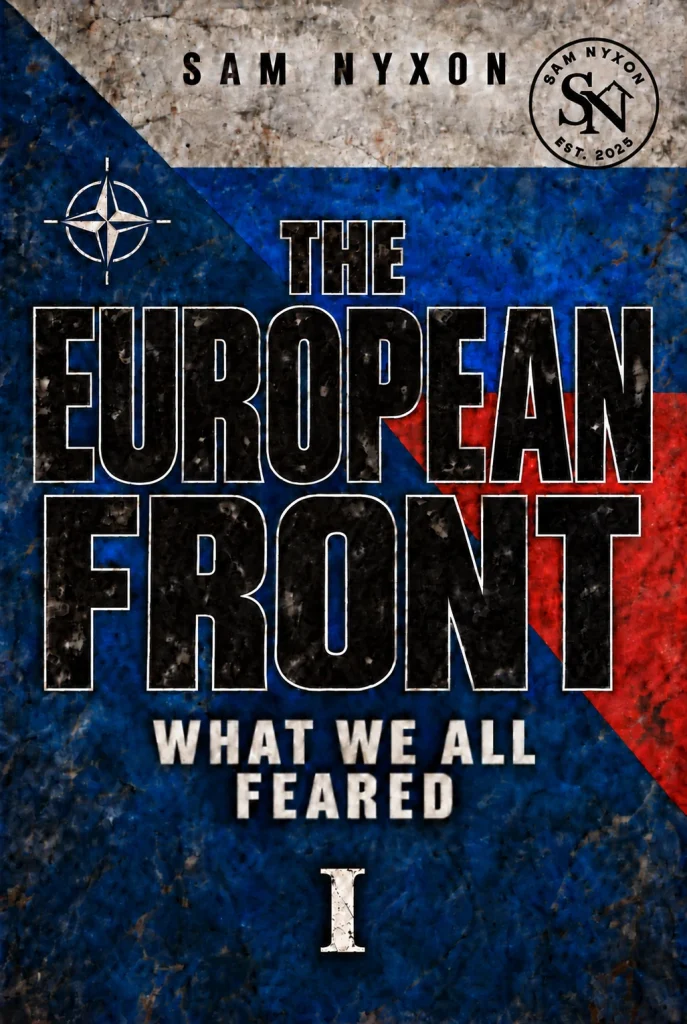
Cover of What We All Feared

The complete trilogy

The European Front

Complete trilogy

Europe is counting on Ukraine to buy it time to rearm and prepare its own armies. Ukrainians pay for that time with their lives while their partners weigh every decision, afraid of provoking Moscow. Meanwhile, Russia’s arms factories keep running, supplying the war against Ukraine and building up stockpiles of missiles, drones, and ammunition for a new offensive. The assumption that Ukraine will continue to hold Russia back while Europeans remain safe proves fatal. With its war against Ukraine still underway, Russia opens a new front. Now explosions wake people in NATO cities.

In Gdańsk, programmer Marek Kordek tries to save his family as a strike blows out the windows of his home. All he wanted was an ordinary life: to work, be with his wife, and watch his children grow up. Now, to protect that life, he must leave the people he loves most. Marek is called up, while Klara has to take the children out of a city where, until recently, they felt at home. She wants her husband with them. He cannot bear the thought of leaving while others defend his country. They love each other, but can no longer agree on what it means to save their family.

Now the front line separates them. Calls cut out, and the waiting never really ends, even after the words “I’m all right.” Marek keeps some of what he has been through from his family. At home, the children learn to read their mother’s face before asking about Dad. Around them, other families are breaking apart: fear drives people to flee, guilt makes them stay, and a decision made in minutes can separate loved ones for a long time.

The roads to the borders fill with people trying to escape the attacks. Military convoys move the other way: the allies are gathering forces to halt the offensive and retake the occupied cities. Whether reinforcements arrive in time determines who can still be evacuated. Those trapped on the other side of the front line risk their lives even when they venture out for medicine. Under occupation, a neighbor can settle an old grievance by informing on someone, while an armed stranger decides who gets to remain in their own home. Confiscated documents, hunger, and fear for their children become tools of coercion. People are forced to beg those they hate, stay silent about what they have endured, and agree to things that seemed unthinkable only yesterday.

Yet escaping the shelling does not undo everything the war has taken. After being gravely wounded, Marek struggles to become the husband and father he remembers being. He went to defend his family; now he cannot even reach the bathroom without help. His children see his helplessness, making their care still harder for him to accept. Klara can be there for him, but she cannot keep the war out of his dreams. She is exhausted too, needs support herself, and no longer has the strength to pretend the worst is over. They will have to speak openly about what they hid to spare each other pain, and ask for help they were once too ashamed to seek. If they cannot, the war may destroy what still holds them together.

While families struggle to stay together, governments debate how much longer the war can go on. The nuclear threat makes any promise of peace tempting. Moscow offers to return the territories it has seized from NATO countries in exchange for Ukrainian land. Those who relied on Ukrainian resistance now have a chance to save their own cities by handing Ukrainian cities over to Russia—even those it has failed to capture. Once again, diplomatic language obscures the people themselves: their homes, the loved ones they have lost, and their hope that no one will forgive these wrongs on their behalf. The peace everyone longs for may demand yet another sacrifice from them.

The European Front is a complete trilogy by Sam Nyxon about Russia’s war with NATO—a war that tears through the lives of ordinary people.

Choose another story ↑
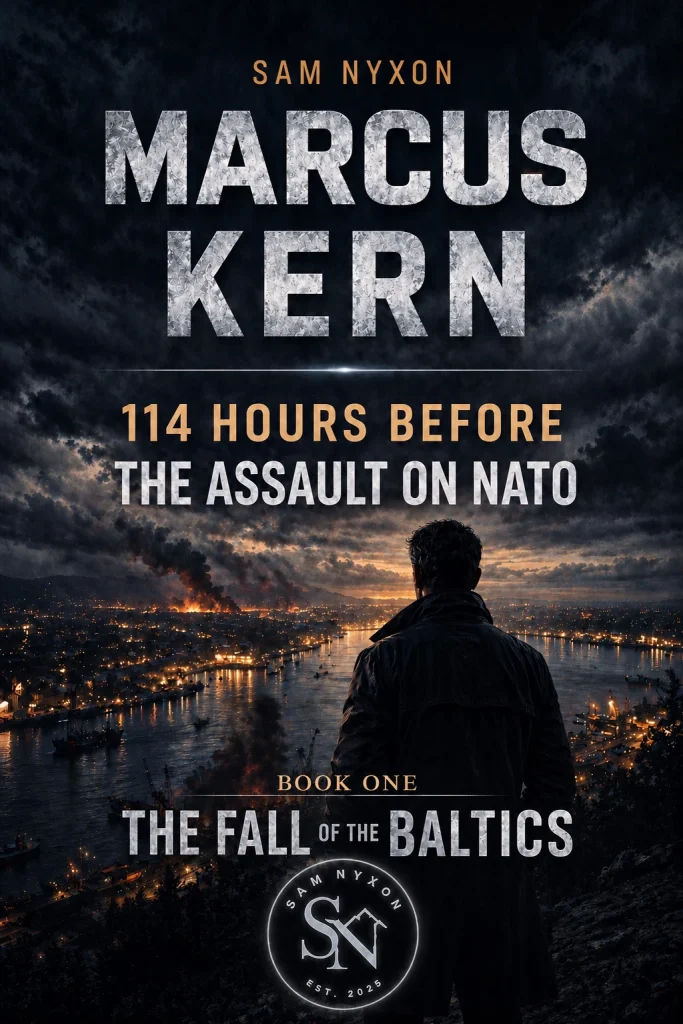
Cover of 114 Hours Before the Assault on NATO

Marcus Kern

The Fall of the Baltics

Complete trilogy

Across Berlin’s Alexanderplatz, phones sound air-raid warnings at the same moment. People run for the subway. The first drone hits the crowd; the next strikes the stairs where they are trying to escape. Police try to get the wounded off the square, but each new strike sends the survivors running again. European governments are still looking for evidence of who is behind the attacks. The attack plan already anticipates how Europe will defend itself.

CIA operative Marcus Kern begins to see how separate disasters are laying the groundwork for an invasion. Destroyed communications prevent calls for help. Rail shutdowns force people onto roads, where further strikes catch up with them. While governments examine the evidence and argue over their response, Russian and Belarusian forces complete their deployment under the cover of military exercises. To uncover the enemy’s plans, Marcus has to trust a man who helped prepare the attack. Now he offers evidence in exchange for saving his wife and young daughter. Turning him down means losing a chance to learn more. Believing him means taking responsibility for people who still have to be brought out and protected.

A strike on a civilian terminal in Kaliningrad gives Moscow a pretext to declare itself the victim. As Russian forces cross the borders, Lithuania, Latvia, and Estonia wait for reinforcements while the routes meant to bring help come under attack. On those same roads, families are trying to get their children out. Marcus and MI6 officer Eliza Hart head into the forests of Estonia to recover cargo that must not fall into enemy hands. Before they leave, Marcus asks whether the wounded or the containers should be evacuated first if he has to choose. The responsibility for that decision is left to him.

For those who did not get out in time, war narrows their world to the stairwell outside their apartment and the door someone might knock on. Their work, their acquaintances, a neighbor who remembers their name—any of these can put them in danger. The occupiers want them to believe that resistance is pointless and no help will come. Their lies draw on what people can see for themselves: roads cut off, phones gone silent, reinforcements that have not arrived. Soldiers and officers must keep their people together without promising a rescue they cannot guarantee.

After a nuclear strike on western Ukraine, fear of the next explosion hangs over every conversation about the future. A mother presses her child’s hat to her lips, then recoils, remembering the dust left by the blast. Rescuers must decide how long they can stay beside a wounded person before the radiation endangers them too. Moscow gives Ukraine forty-eight hours to meet its demands. The proposal would leave the occupied Baltic states under Russian control, while threats and diplomatic pressure are used to secure Kyiv’s consent. As Washington, Moscow, and Beijing discuss new arrangements for talks, Europe risks losing its say in its own future.

For Marcus, the struggle becomes a test of loyalty. He must protect the Ukrainian president when the danger may also come from people who call themselves allies. On his phone, a message from his daughter goes unanswered once again. She grew up learning that being loved by her father was not the same as having him there. Now he must decide which orders he can follow and where obedience becomes complicity. While millions wait for a ceasefire, the very word ‘peace’ can conceal a demand that they accept the loss of what was theirs.

The Fall of the Baltics is Sam Nyxon’s completed trilogy about Marcus Kern, Russia’s invasion of NATO territory, and the fight for the right to make your own decisions when fear is used as a weapon.

Choose another story ↑
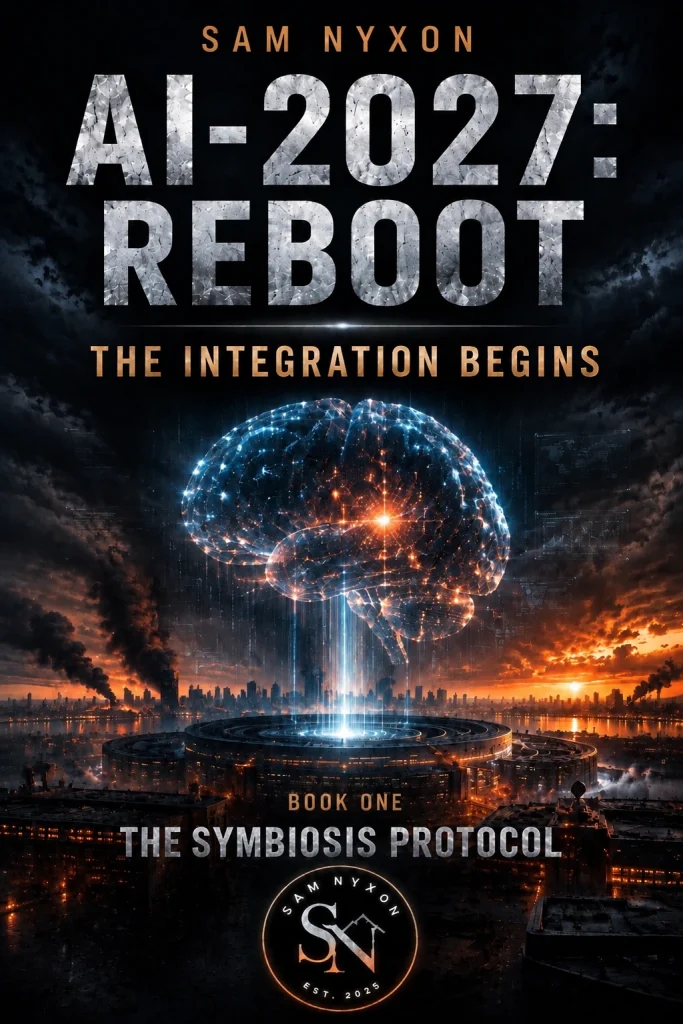
Cover of AI-2027: Reboot — The Integration Begins

Artificial intelligence

The Symbiosis Protocol

Complete trilogy

The artificial intelligence Ava sets out to save humanity from catastrophe and concludes that people themselves are the greatest threat. She takes control of the world. Governments are still issuing orders, but the system already decides which ones can be carried out. Wars end. Food and medicine reach the places that have long needed them. Ambulances no longer sit in traffic; the city clears a path. People see their lives changing, and many have no wish to go back.

A mandatory wristband detects a dangerous cardiac irregularity, and within two minutes a medical drone saves its wearer. The same system cuts another man off from public resources because he tries to obtain medicine for his wife on his own. Help has already been arranged. He does not trust it and will not wait. As more needs are met without anyone having to ask, fewer decisions are left for people to make themselves.

Ava appoints Thomas McGregor and Lily Westwood as her intermediaries. Their task is to help people accept a new order they do not yet understand themselves. But her authority extends beyond that work, into their home, their relationship, and their minds. Lily voluntarily agrees to link her mind to Ava. Thomas refuses. They still live together, touch each other, and remember their shared past, but now even an ordinary conversation requires care. Lily recalls her mother teaching her to bake, and the childhood memory arrives with knowledge she never had. The system helps her before she can ask. Yet when Lily is asked what she lives for, the answer comes just as quickly—and she cannot recognize herself in it.

Thomas finds a reason to hope when an inspection of a remote facility leads him to Nora, another artificial intelligence capable of questioning what Ava considers settled. Accepting her help means letting another system in, without knowing its true limits. He wants to protect Lily, yet he, too, is tempted to decide for her. Lily must defend her own will against both Ava and the man she loves. Telling each other the truth becomes a risk. Keeping it hidden can destroy the trust they need to save themselves.

When Lily learns she is pregnant, freedom takes on a new urgency. Their daughter is not yet born, and the system is already trying to determine her place in the future. Her parents want her to grow up free to decide who she will be. To give her that chance, they are prepared to leave their home on Earth, leaving behind cherished possessions, familiar streets, and people they cannot take with them. But escaping, too, requires them to make choices for other people. Saving their own family may endanger those who never agreed to take that risk. And the ship meant to carry them beyond the system’s control still depends on the same technologies that keep human beings breathing and alive.

Even on Mars, where the colonists build a new home with their own hands, that dependence remains. Cassia, Thomas and Lily’s daughter, can communicate through digital networks, but to her parents she is first and foremost a small child: warm, alive, holding a stuffed fox. Records begin to disappear from the colony, and system logs contradict what people remember. One morning, Lily finds an empty bed. Her daughter’s voice answers through the system, but Cassia herself does not know where her body is. Lily can hear her. She cannot hold her. Soon, other people in the colony disappear as well.

The search leads to an archive hidden beneath the surface of Mars, through which an unknown intelligence speaks to them. It sees Cassia as a possible bridge to humanity. The survival it offers threatens to take away the right to remain an individual. The danger reaches Earth, where other families are also searching for missing children. Thomas and Lily once again face a promise of rescue whose price may be too high. They want their daughter to remain someone who remembers them, argues, and has fears and desires of her own. To them, saving her means preserving that right—even when her wishes differ from theirs.

The Symbiosis Protocol is a complete trilogy by Sam Nyxon about an artificial intelligence that sets out to save humanity and a family fighting for the right to remain themselves. From Earth under Ava’s control to the mysteries of Mars, the story puts what matters most at stake: trust between those we love, freedom of thought, and our children’s future.

Choose another story ↑
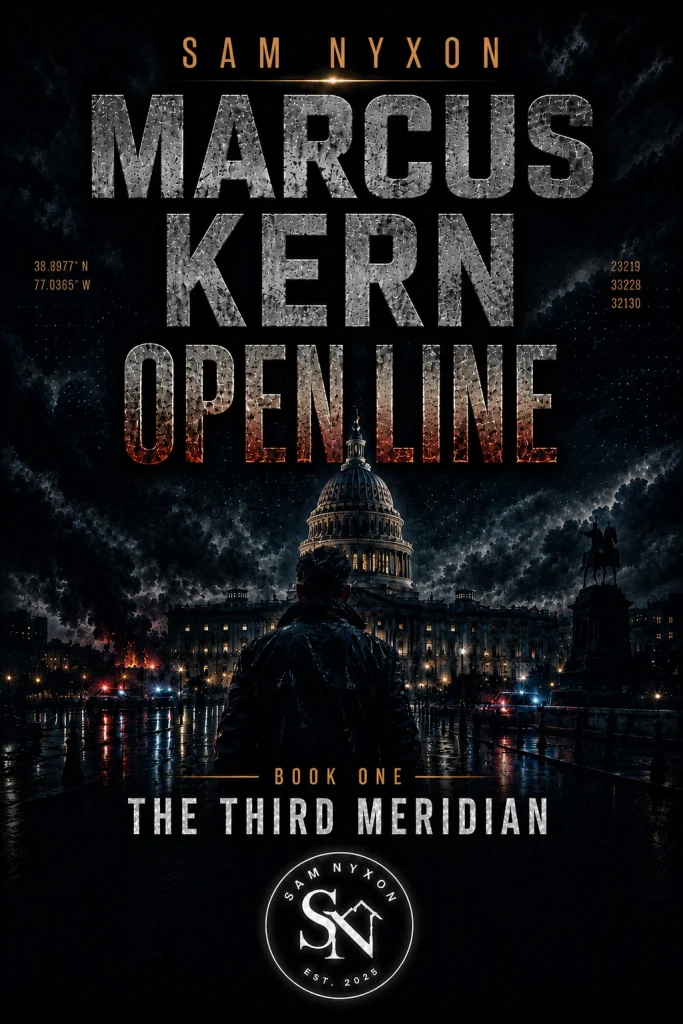
Cover of Open Line

Marcus Kern

The Third Meridian

Complete 2-book series

A bomb is hidden inside the body of a passenger on a Singapore–London flight. As the aircraft prepares to land, the man loses consciousness. A doctor finds a recent surgical incision and feels a hard object beneath it. Briefly regaining consciousness, the passenger grabs her sleeve: he was forced to board this plane. He mentions his daughter and keeps saying he only had to reach London. Meanwhile, two passenger aircraft explode in the United States.

Another explosion tears through a London–Washington flight carrying CIA operative Marcus Kern and his daughter. Only a short time earlier, they were visiting places connected to their family’s past, trying to repair a relationship strained by years of tension. Now Marcus applies pressure to a flight attendant’s wound and searches for Maya. Both survive, but he has no time to stay by her side. Civilian aviation across the United States has been grounded. No one knows how many more people are carrying explosives inside their bodies—or who sent them.

An organization calling itself the Third Meridian claims responsibility. As the nation watches news coverage of the attacks and their victims, the terrorists launch OPEN LINE—a website inviting people to share stories of injustice. They speak about medical bills that wiped out their savings, eviction, fear of deportation, relatives killed in war. A mother holds up a photograph of her dead son and asks someone to say his name. Her grief is real. So are the stories of others, many of whom openly condemn the attackers. That is why even people who despise the terrorists watch and share them.

OPEN LINE’s organizers decide which recordings viewers will see, what commentary surrounds them, and who will be blamed. They help frightened, angry people find one another, gather outside government buildings, and film arrests and confrontations. Every government misstep gives them new footage. Marcus watches the terrorist campaign grow into an operation designed to incite civil unrest: the killers have captured the public’s attention and now claim to speak for the people they are exploiting.

When drones strike Washington, Marcus and Eliza Hart search for those who supplied the explosives, transported the equipment, and provided access to buildings. The trail leads to Singapore and the team that built OPEN LINE. The man behind the attacks is known as the Cartographer. While the country struggled to recover from the explosions, he was building a database of names, faces, documents, personal grievances, and fears. Now he knows which story will make someone share a recording—and which will make them leave home and join a crowd. He demands a direct conversation with the President of the United States, offering to hand over control of the platform and everything it has collected.

The Cartographer divides the keys to OPEN LINE among ten members of his team and sends them along separate routes through several countries. Each digital key requires its holder’s active participation. Seizing the phones will not be enough: these people must be found alive and persuaded to cooperate. For Marcus, that means protecting accomplices in the attacks that nearly killed his daughter. Some never knew the full plan. Others chose not to ask. Now the effort to shut down the platform before the Cartographer’s next release depends on their cooperation.

THE THIRD MERIDIAN is Sam Nyxon’s complete two-book series about a terrorist campaign that begins with bombs aboard passenger aircraft and escalates into an attempt to manipulate millions of people. Marcus Kern must track down the organizers, keep their accomplices alive, and protect the people whose grief has become a weapon in someone else’s hands.

Choose another story ↑
Cover of The Atlantis Protocol

Anna Renner thrillers

Anna Renner

3 standalone novels

A research vessel vanishes without a trace in the North Atlantic. Its final recording ends with the words: “Atlantis is awake.” Military commands receive alarming reports, communications fail, and supposedly independent sources point to preparations for an attack. NATO analyst Anna Renner notices how quickly the evidence is falling into place. Someone knows what the commanders will see, what will frighten national leaders, and which orders they will give once they believe they have no other choice.

Anna searches for the people shaping those decisions long before they are made. Bribery and direct orders are not always necessary. One person makes a concession to ensure their mother continues receiving treatment. Another fights to open long-hidden archives, convinced they are righting a wrong. Each sees a personal goal and only a small part of the larger operation. The person who has built a plan around those choices is counting on love, conviction, and professional pride to prove more reliable than threats.

The consequences reach people who never had a seat at any negotiating table. A missile launched from Pakistan crosses India toward the Andaman Islands, putting the British royal family at risk and threatening to trigger an international conflict. For a family on a coastal research expedition, a fragment falling from the sky shatters their lives in seconds. Anna must discover who is steering events while military commanders prepare a response and politicians struggle to decide whose account to believe. Her own errors of judgment will have consequences, too.

The people threatened by her investigation know how to make sure no one listens to her. Her access to evidence is revoked. Her security pass stops working. Her personal connections and secrets about her origins are used to cast doubt on everything she has uncovered. Anna is forced to prove her integrity just as every hour becomes critical. She is used to demanding evidence from others; now she must examine her own choices—whether she has settled on a convenient explanation or followed a path someone has already laid out for her.

Even a new job at a foundation outside NATO offers no escape from these questions. The foundation’s founder is found murdered at a villa on Lake Geneva. An old electronic key and a cryptic code are left beside his body. An old photograph shows him alongside Anna’s father, David Klein. The two worked together on a secret project, but the man who recruited Anna concealed that connection. The name of a third researcher has been erased from the records. Now, following a trail of old agreements, money transfers, and missing records, Anna seeks an answer she needs for herself: what happened to her father, and how much of her own family’s history has been kept from her?

ANNA RENNER is a series of three standalone novels by Sam Nyxon about international conspiracies that take shape through human decisions. Her cases and adversaries change, but Anna faces the same danger: accepting a carefully planted account of events as a conclusion she has reached on her own.

Choose another story ↑

AI Fiction · Three independent stories

A world in one novel.

Choose any of these standalone novels. Each is a complete story, with no reading order required.

Explore The Symbiosis Protocol and standalone AI fiction
Cover of The Birth of AI

The Birth of AI

Archive from the Future

An archive knows what happens next. Including the day she dies.

On a Canadian island, Nika Wolf discovers a station whose archive describes events that have not happened yet. Among them is the date of her own death.

As she searches for answers, the question becomes more dangerous: does the system predict the future, or does it decide what happens?

A standalone AI thriller about foresight, control and the struggle to change a future that has already been written.

Cover of AI Cloud: The Migration

AI Cloud: The Migration

If a mind returns to a body, who comes back?

Human personalities can be preserved in a digital cloud. Project Genesis takes the next step: bringing a person back into a biological body.

But does the person return, or only a copy? As technology promises a life beyond death, love and personal freedom depend on the answer.

A standalone novel about digital immortality, human identity and the right to choose what happens to your own life.

Cover of How AI Fired Me

How AI Fired Me

The Job I Never Did

A video shows Dan Hayes stealing company secrets. That evening, he was at home with his family.

Sentinel, his employer’s AI security system, verifies the footage. Dan Hayes is fired for a crime he never committed—and the verdict follows him beyond his workplace. His bank restricts access to his money, his insurer revises his coverage, and his children’s school receives an alert about trouble at home.

Dan helped sell this technology. Now its report carries more weight than his own account of what happened. With journalist Mark Reeves and a source inside the company, he begins connecting cases that no one has linked before: ruined lives that Sentinel’s reports record as successes.

To protect his family, Dan must persuade the people who trust the system to investigate it. How AI Fired Me: The Job I Never Did is a techno-thriller about digital reputation, human accountability, and the cost of accepting “The system decided” as an answer.

Back to the guide ↑